


How we work with you

Deep Search

We access the 80% of top talent who aren't actively looking — the professionals already excelling in roles who would move for the right opportunity.

Sector Expertise

With decades of experience across investment, asset management, private markets and FinTech, we speak your language and understand your world.

Strategic Partnership

From a single critical hire to building entire teams, we design bespoke solutions around your specific challenge — not an off-the-shelf process.

Boardroom-level conversations, handled with discretion

Where careers and strategic hiring decisions take shape — quietly, expertly, and with the long view in mind.

What people say

"We worked with Hanton's Consulting and Tamsin and her team on recruiting for a senior member of our Investment team. The brief was somewhat niche in nature, however they delivered several strong candidates for the role. Communication throughout the process was regular and clear and we landed on a great result — hiring someone we would not have found otherwise. I recommend Hanton's Consulting particularly for those 'hard to place' roles."

CEO  ·  Impact Investment Fund

"I worked with Tamsin for many years. She always impressed me with her knowledge of the industry and her tenacity. Tamsin is someone I trust hugely to deliver what she promises."

Former Colleague  ·  Financial Services

"Tamsin took time to really understand what I was looking for — not just the role, but the culture, the team, and where I wanted to go. The process was seamless and completely confidential throughout."

Investment Professional  ·  Candidate

Sectors we serve

Our focus is deliberate and narrow — deep networks, genuine market knowledge, candidates who are genuinely relevant.

Asset Management Private Equity Infrastructure Funds FinTech ESG & Sustainable Investment Advisory & Consulting

Frequently asked questions

Hanton's Consulting is a specialist talent and recruitment consultancy built exclusively for the investment ecosystem. We partner with global investors, asset managers, private and public markets platforms, infrastructure funds, FinTech and advisory firms to build high-performing, future-ready teams.
Retained search is our most comprehensive service — a thorough search across the entire relevant candidate market, mapping talent regardless of job-seeking status. Contingency recruitment provides access to our network on a no-placement, no-fee basis, best suited to roles where speed and availability are the primary requirements.
Yes — this is central to how we work. Most of the professionals we place weren't actively looking. We access the 80% of top talent who are excelling in their current roles but open to the right conversation. Our deep sector relationships and niche database allow us to reach these professionals directly.
Simply get in touch via the contact form or book a 30-minute introductory call. We invest time understanding your organisation, culture, and the precise impact the hire needs to make before beginning any search.
Absolutely. Every search, every conversation, and every candidate registration is handled with complete discretion. Candidate details are never shared with any third party without explicit consent. Confidentiality is a core principle of everything we do.

Ready to find exceptional talent — or your next exceptional role?

Every search is different. Let's start with a conversation.

Tamsin Bradberry, Founder of Hanton's Consulting

Tamsin Bradberry

Founder & Managing Director

The investment world moves fast. Getting talent right — first time — matters enormously.

I'm the founder of Hanton's Consulting, a specialist talent and recruitment consultancy built specifically for the investment ecosystem. We partner with global investors, asset managers, private and public markets platforms, infrastructure funds, FinTech and advisory firms to build high-performing, future-ready teams.

Whether you need a single critical hire, a leadership replacement, or a partner to build an entire team from the ground up, we design bespoke solutions around your specific challenge — not an off-the-shelf process. Our flexible model scales from targeted executive search to embedded fractional RPO, supporting growth across multiple regions and at every stage of a fund or platform's journey.

What sets us apart is the depth of our network and the quality of our search. We access the 80% of top talent who aren't actively looking — the professionals already excelling in roles who would move for the right opportunity.

We are also closely attuned to the rapid evolution of AI in business — advising clients on its best applications in talent strategy, reducing operational costs, and ensuring their teams are equipped to harness its power competitively.

Above all, we are a values-driven consultancy. With a particular passion for ESG and sustainable investment, we believe the best teams are diverse, inclusive, and built for long-term impact — not just immediate performance.

Our values

Discretion

Every search, every conversation, every mandate is handled with absolute confidentiality. Always. In financial services, discretion is not a feature — it is a non-negotiable.

Depth

We go beyond the active market. Our searches are thorough, our networks deep, and our understanding of your sector genuine. We don't fill roles — we find the right people.

Purpose

We believe great hiring changes organisations. With a passion for ESG and diversity, we build teams for long-term impact — not just immediate performance. We take that responsibility seriously.

If you're a hiring leader or an investment professional considering your next move

I'd love to connect. Every conversation is confidential.

Bespoke talent solutions for the investment sector

We don't offer one-size-fits-all recruitment. Every mandate is treated as a unique challenge, designed around your organisation, culture, and growth plans.

Client mandate — bespoke talent solutions from Hanton's Consulting
01

Retained Search & Selection

Our most comprehensive service. A thorough search across the entire relevant candidate market — mapping talent and identifying the best fit regardless of job-seeking status. Ideal for senior, specialist, or confidential roles.

02

Contingency Recruitment

Access to our ever-growing network of specialist talent on a no-placement, no-fee basis. Best suited to roles where speed and availability are the primary requirements.

03

Interim, Contract & Fractional

Flexible, fast solutions for roles requiring short-term coverage, project delivery, transformation support, fractional leadership, or bridge hiring without long-term commitment.

04

Talent Mapping & Market Intelligence

Bespoke competitor and market analysis providing organisations with the data they need to make informed short and long-term hiring and succession decisions.

05

Fractional RPO & Embedded TA

For organisations scaling rapidly or entering new markets, we embed as a fractional talent partner — acting as your in-house recruitment function without the overhead.

06

AI Talent Advisory

We help organisations understand and harness AI in their talent strategy — from reducing hiring costs to upskilling teams and future-proofing their workforce against rapid technological change.

Trusted partners

Through a carefully selected network of specialist partners, we extend our offering beyond search and placement — giving clients access to expert services that support the full talent lifecycle, coordinated through a single trusted relationship.

Executive Coaching

Leadership development

Senior leadership coaching for newly placed executives and high-potential talent — supporting the transition into role and long-term performance in the investment environment.

Psychometric Assessment

Selection intelligence

Rigorous psychometric and cognitive assessment to support senior hiring decisions, reduce selection risk, and provide deeper insight into candidate fit beyond the interview.

Workforce & Talent Assessment

Organisational capability

Team capability reviews, succession planning assessments, and talent benchmarking — giving investment firms a clear picture of their current and future human capital position.

ED&I Consulting

Inclusive hiring practice

Specialist ED&I advisory and inclusive hiring frameworks for financial services firms committed to building diverse, high-performing teams that reflect the world they serve.

All extended services are delivered by independent specialist partners. Partner details and credentials available on request. Get in touch to discuss how these services can support your specific requirements.

How we work

1

Brief

We invest time understanding your organisation, culture, and the precise impact this hire needs to make.

2

Search

We map the market, activate our network, and conduct thorough deep search — reaching candidates others can't access.

3

Shortlist

You receive a curated shortlist of thoroughly assessed, genuinely relevant candidates — never volume, always quality.

4

Placement & beyond

We manage through to offer, acceptance, and onboarding — and stay close to ensure the hire lands well.

Our fees: We work on retained and contingency bases depending on the mandate — get in touch to discuss what works best for your requirements.

Every search is different. Let's talk about yours.

Confidential conversations welcome.

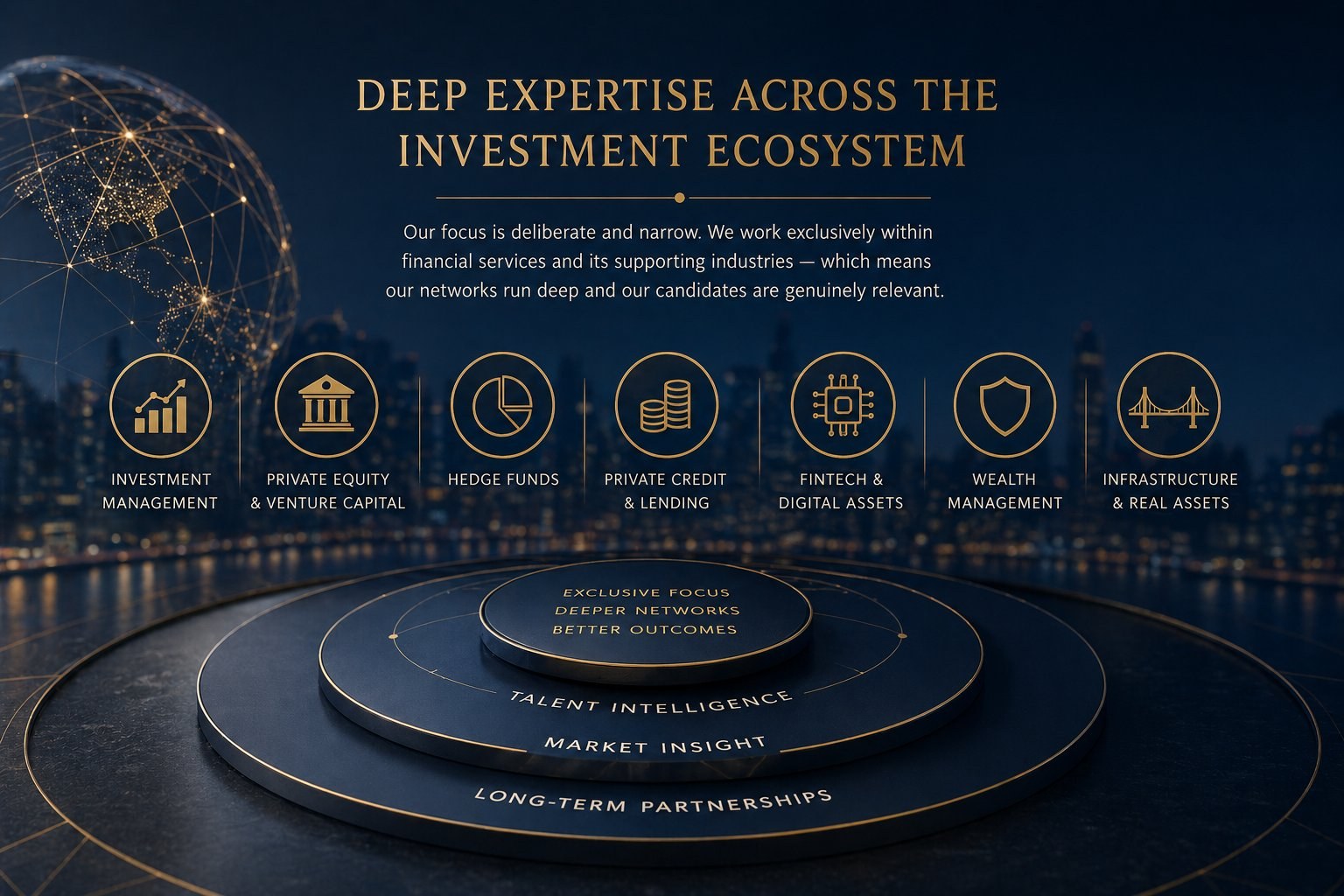
Deep expertise across the investment ecosystem

Our focus is deliberate and narrow. We work exclusively within financial services and its supporting industries — which means our networks run deep and our candidates are genuinely relevant.

Deep expertise across the investment ecosystem — Hanton's Consulting
01
Asset Management

From boutique fund managers to global multi-asset platforms, we understand the operational, investment, and distribution talent requirements that drive performance. Our network spans portfolio management, research, risk, compliance, operations, and client-facing functions across the full spectrum of asset classes and strategies.

02
Private Markets

The private markets space demands investors and operators who are comfortable with complexity, ambiguity, and long-term value creation. We work with GPs, LPs, and emerging managers across the full deal lifecycle — from origination through to exit — placing investment professionals, deal teams, and operational talent across private equity, venture and growth equity.

03
Infrastructure & Real Assets

A sector defined by long-term thinking and specialist expertise. We support infrastructure funds, asset owners, and advisory firms in finding the investment, asset management, and ESG professionals who understand the unique demands of this space — from greenfield development through to operational asset management.

04
FinTech & Financial Innovation

From payments and lending platforms to RegTech, WealthTech, and digital assets, we work with FinTech businesses at every stage — from founding team hires through to scaling leadership appointments. We understand both the technical and commercial talent requirements that define success in this rapidly evolving sector.

05
ESG & Sustainable Investment

ESG is no longer a specialism — it is central to investment decision-making. We have a particular passion for this space and deep relationships with professionals working across responsible investment, impact, sustainability, and climate finance. We understand both the regulatory frameworks and the genuine conviction required to build effective ESG teams.

06
Advisory & Consulting

The ecosystem of firms supporting the investment industry — strategy consultancies, research providers, data and analytics businesses, and specialist advisory firms. We understand both sides of the client relationship and can place professionals who move fluidly between advisory and principal investment environments.

Deep in your sector. Ready to find your next hire.

Get in touch to discuss your specific requirements.

Your next move, handled with discretion

Most of the professionals we place weren't actively looking. They were excelling in their current roles — but open to the right conversation. If that sounds like you, we should talk.

Building careers in financial services — Hanton's Consulting

Why register with us

Absolute confidentiality

Your details are never shared without your explicit consent. We understand the sensitivity of career conversations in the investment world. Discretion is non-negotiable.

Genuine market insight

We give you an honest picture of the market — compensation benchmarks, demand for your skill set, and where the real opportunities are. No spin, no false promises.

Access to the hidden market

Many of our mandates are never advertised. Registering with us gives you access to opportunities you won't find on job boards — roles filled quietly through trusted networks.

Expert guidance

From CV review and interview preparation through to offer negotiation, we support you through every stage of the process — with honest, experienced advice at every step.

Heard from our network

"Tamsin took time to really understand what I was looking for — not just the role, but the culture, the team, and where I wanted to go. The process was seamless and completely confidential throughout."
Investment Professional
"You have been the best recruiter I have ever worked with. You listened, you understood my sector, and you only put me forward for roles that genuinely suited me. I wouldn't hesitate to recommend Tamsin."
Senior Advisor - Financial Services

Register in confidence

Your information is held in strict confidence and will never be shared without your explicit consent. By submitting this form you agree to Hanton's Consulting contacting you regarding relevant opportunities.


Shaping industry discourse and networks

Articles, conversations, and events from the Hanton's Consulting network — practical thinking on hiring, talent strategy, and the forces shaping the investment sector.

Global Insights, Media and Events — Hanton's Consulting
Articles Media Conversations Events

Articles & market commentary

Practical thinking on hiring, talent strategy, and the forces shaping the investment sector workforce.

UK Employment Rights Act 2025 — what hiring managers need to know

The most significant changes to UK employment law in a generation. Day-one unfair dismissal, fire and rehire reforms, harassment liability — and what financial services firms must do now.

Read article →

Market conversations

An ongoing series of conversations with investment professionals, hiring leaders, and market specialists — covering talent trends, sector dynamics, and the forces shaping the investment ecosystem.

First episode coming soon

Market Conversation
Coming soon

First in the series

Our first market conversation — available shortly. Register your interest below to be notified when new episodes are published.

More episodes coming soon

Coming soon

Next episode

Register below to be notified when new episodes are published.

About this series

Market Conversations is an ongoing series of candid discussions with senior professionals across the investment ecosystem. Episodes cover talent strategy, hiring trends, sector developments, and the leadership challenges facing investment firms today.

Convening the investment community

We convene senior investment professionals for intimate roundtables, market insight sessions, and networking events.

Upcoming events

We are currently planning our next series of events for the investment community. Check back shortly for details of upcoming roundtables and insight sessions.

Employment Law
April 2026  ·  12 min read  ·  Tamsin Bradberry

UK Employment Rights Act 2025 — What Hiring Managers Need to Know

The most significant changes to UK employment law in a generation. For financial services firms, the implications for hiring, contracting, and workforce planning are substantial.

The Employment Rights Act 2025 received Royal Assent in July 2025. Its provisions are being implemented in phases, with the most consequential reforms taking effect between April 2026 and January 2027. The window for preparation is shorter than many firms realise.

Day-One Unfair Dismissal Rights

From July 2026, employees will acquire the right not to be unfairly dismissed from their first day of employment. The current two-year qualifying period will be removed. A statutory probationary period of nine months is expected to apply, but detail remains subject to government consultation and secondary legislation.

The comfort of a two-year window will disappear. From the moment an offer is accepted, firms will need to be in a position to evidence their reasons for any dismissal decision. Evidence-based performance conversations, diarised review points, and contemporaneous documentation will carry greater legal weight from day one.

Analysis published by Marks Sattin in January 2026 noted a drop in permanent placements in Q4 2025 alongside a rise in interim and temporary hires, driven by employer caution ahead of the reforms. The interim and contract market in financial services is positioned to absorb some of that demand.

Zero-Hours Contracts and Flexible Working

The Act does not ban zero-hours contracts outright, but introduces significant new obligations where workers' actual hours regularly exceed their contracted minimum over a 12-week reference period. Firms engaging contractors through umbrella structures should monitor the ongoing government consultation closing 1 May 2026.

On flexible working, employers who reject a request must now specify their reasons from a defined list and explain why refusal is reasonable. While changes do not take effect until 2027, updating policies and training line managers should be part of any preparation roadmap now.

Harassment Liability: A New Dimension for Client-Facing Roles

From 6 April 2026, sexual harassment becomes a qualifying disclosure under whistleblowing law. The employer duty now extends to harassment by third parties including clients, customers, and visiting contractors. For client-facing roles in banking, asset management, and wealth management, this requires proactive policy review, training, and clear intervention protocols.

Fire and Rehire

From January 2027, dismissing an employee for failing to agree to changes in core contractual terms will constitute automatically unfair dismissal. The restriction extends to fire-and-replace situations. Firms that have historically used contract renegotiation as a cost management tool should take specialist employment law advice before any such exercise post-January 2027.

Collective Redundancy and Tribunal Time Limits

The maximum protective award in collective redundancy doubles from 90 to 180 days' pay per affected employee. From October 2026, the time limit for most tribunal claims extends from three to six months — widely expected to increase volumes in an already strained system.

The Bigger Picture for Financial Services

The ERA 2025 represents a deliberate rebalancing of the employer-employee relationship. For financial services firms, the challenge is ensuring employment law compliance is treated with the same systemic rigour as regulatory compliance. Firms that use 2026 to modernise their hiring practices and update their documentation will be materially better positioned when the January 2027 reforms take full effect.

Practical Priorities for Hiring Managers — Now

  • Move towards probationary periods of three to four months with structured, documented reviews before employees reach six months' service.
  • Audit all employment contracts and update day-one entitlements effective 6 April 2026.
  • Train line managers on constructive dismissal risk from January 2027.
  • Review and update your sexual harassment prevention policy ahead of April 2026.
  • Brief recruiting managers that the two-year buffer mindset must change before July 2026 hiring decisions.
  • Assess your use of zero-hours and flexible contracts where working patterns have become regular in practice.
  • Take specialist employment law advice before any contract renegotiation engaging the fire and rehire rules from January 2027.
  • Monitor the umbrella company consultation closing 1 May 2026.
Important notice: This article is provided for general informational purposes only and does not constitute legal advice. Employment law is complex and fact-specific. Firms should obtain qualified employment law advice tailored to their specific circumstances before making decisions in response to these reforms.
Sources include: legislation.gov.uk  ·  GOV.UK  ·  Acas  ·  CIPD  ·  Freshfields  ·  Clyde & Co  ·  Bird & Bird  ·  DLA Piper  ·  Reed Smith  ·  Marks Sattin  ·  Lewis Silkin  ·  Morgan Lewis  ·  Browne Jacobson

Questions about hiring in the current environment?

We help financial services firms navigate talent decisions with confidence.

Talent Strategy
March 2026  ·  10 min read  ·  Tamsin Bradberry

Neurodiversity in the Investment Workplace — From Challenge to Competitive Advantage

The investment sector has long underutilised neurodiverse talent. The evidence is compelling: firms that actively recruit for cognitive diversity consistently outperform their peers.

The investment sector has long underutilised neurodiverse talent. The evidence for change is compelling — but the business case depends on what firms are genuinely willing to redesign, not just declare.

February 2026 | 9 min read | Talent Strategy & Inclusion

Estimates consistently place the proportion of neurodivergent people in the UK population at around 15 to 20 percent. The Diversity Project — the cross-industry initiative focused on inclusion in the investment and savings sector — has made neurodiversity a dedicated workstream, running annual surveys of neurodivergent employees across member firms since 2022. The CIPD's Neuroinclusion at Work report, published in 2024, surveyed over a thousand employed adults and found that nearly a third of organisations have no neuroinclusion focus at all. Only 33 percent of those that do have it embedded in their formal EDI strategy. For a sector that prides itself on analytical rigour and talent-led performance, the gap between aspiration and practice is wide — and the costs, both human and commercial, are becoming harder to ignore.

What Neurodiversity Actually Means — and Why Precision Matters

Neurodiversity refers to the natural variation in how human brains process information, learn, and communicate. The umbrella term encompasses a range of conditions including autism spectrum condition, ADHD, dyslexia, dyspraxia, dyscalculia, and Tourette's syndrome, among others. In practice, these conditions frequently co-occur, and no two neurodivergent individuals present identically. The investment sector's tendency to collapse this diversity into a single, undifferentiated category is itself a source of mismanagement — the cognitive profile of a highly systematic autistic analyst is not the same as that of a creative, fast-processing professional with ADHD, and HR and line management frameworks need to reflect that complexity.

The term "neurodiversity" also carries a conceptual distinction worth preserving in professional contexts: it describes the full range of human cognitive variation, not a deficit or a medical category. Neurodivergent individuals — those whose cognitive profiles diverge from what is conventionally expected — face real challenges in environments designed without them in mind. But those same profiles frequently carry strengths that are directly applicable to the analytical, pattern-recognition, and risk-identification functions that investment management demands.

A note on the evidence base: Much of the published data on neurodiverse talent and productivity comes from structured employer programmes — particularly in technology and financial services — rather than randomised controlled research. The findings are directionally consistent and commercially credible, but they reflect the outcomes of specific, well-designed interventions. The competitive advantage is real — but it is not automatic. It depends materially on how firms recruit, onboard, manage, and support neurodiverse employees. The data should be read as evidence for what becomes possible, not as a guarantee that accrues by merely hiring from this pool.

The Evidence: What the Data Actually Shows

The most-cited programme evidence in financial services comes from JPMorgan Chase's Autism at Work initiative, launched in 2015 as a four-person technology pilot. Within the first six months, participants were found to be 48 percent more productive than peers who had been in equivalent roles for three to ten years. The programme — now employing staff across more than forty job roles in nine countries — has maintained a retention rate of close to 99 percent. JPMorgan has publicly attributed specific value-generation to neurodiverse team members, including early risk identification in technology and structured interest rate risk functions.

Two caveats are important when citing this figure. First, as researchers and commentators have noted, the productivity differential partly reflects careful job matching and role design, not simply the hiring of autistic professionals into standard roles. Second, some of the wider figures in circulation — including a claim that autistic employees were "90% to 140% more productive" — have a less clearly documented evidential basis and reflect specific role contexts rather than a generalised productivity premium across all neurodiverse hires. Investment firms should be wary of reaching for headline statistics without understanding what specific conditions generated them.

The broader picture from sector-level research is consistent but more nuanced. The CIPD's 2024 neuroinclusion report found that one in five neurodivergent employees surveyed had experienced harassment or discrimination at work because of their neurodivergence. A third reported that their workplace experience had negatively affected their mental wellbeing. Thirty-one percent had not told their line manager or HR about their neurodivergence — the most common reason being fear that their organisation would not be understanding or offer support. Only 37 percent felt their organisation provided meaningful support.

The Evidence at a Glance

15–20%
Estimated proportion of the UK population that is neurodivergent in some way — a significant share of any investment firm's existing workforce.
City & Guilds Neurodiversity Index 2025; CIPD Neuroinclusion at Work 2024
1 in 5
Neurodivergent employees who reported experiencing harassment or discrimination at work because of their neurodivergence.
CIPD Neuroinclusion at Work Report, 2024
32%
Organisations that have no focus on neuroinclusion at all — despite 70% saying EDI is a critical priority.
CIPD Neuroinclusion at Work Report, 2024
27%
Employers that offer line managers any training in what neurodiversity is and why it matters to the business.
CIPD Neuroinclusion at Work Report, 2024
99%
Retention rate reported by JPMorgan Chase, SAP, Microsoft, and EY across their structured neurodiversity hiring programmes.
Multiple company programme reports; cited in LSE Business Review, 2026

The Investment Sector's Specific Alignment

What makes neurodiversity particularly relevant to investment management is the alignment between certain neurodivergent cognitive profiles and the work the sector actually values most. Autistic professionals frequently demonstrate strong pattern recognition, systematic thinking, and the capacity to sustain intense analytical focus over long periods — qualities directly applicable to quantitative analysis, portfolio risk assessment, compliance monitoring, and data-intensive research roles. Professionals with ADHD often bring rapid, associative thinking and a capacity for creative hypothesis generation that complements more systematic analytical work. Dyslexic professionals are consistently associated with strong three-dimensional and spatial reasoning, big-picture strategic thinking, and the ability to synthesise complex information across domains.

The risk identification dimension deserves particular attention. Research published across multiple contexts — including JPMorgan's own programme reporting — highlights that neurodiverse professionals in analytical roles frequently identify anomalies, edge cases, and systemic vulnerabilities that neurotypical colleagues miss. In a sector where the cost of missed risk is asymmetric and potentially catastrophic, this is not a marginal consideration.

The cognitive profiles most common among neurodivergent professionals — pattern recognition, systematic analysis, and anomaly detection — map directly onto the functions investment firms pay most for.

The groupthink risk is equally relevant. Investment decision-making is demonstrably improved by cognitive diversity in teams — teams that include individuals with genuinely different ways of processing information are more likely to surface contrarian views, stress-test assumptions, and avoid the convergent thinking patterns that have preceded significant market misjudgements. Hiring for cognitive conformity, even highly qualified cognitive conformity, is a structural risk factor that firms have historically underweighted.

The Legal Framework: What UK Firms Must Understand

Neurodiversity is not simply a talent strategy matter in the UK — it is a legal one. Many neurodivergent conditions meet the statutory definition of disability under the Equality Act 2010, which requires a physical or mental impairment that has a substantial and long-term adverse effect on the individual's ability to carry out normal day-to-day activities. Crucially, as Acas has confirmed, a formal medical diagnosis is not required for protection to apply — evidence of impairment is sufficient. This has direct implications for how investment firms must conduct themselves throughout the hiring process and during employment.

Under section 20 of the Equality Act, employers have a duty to make reasonable adjustments where a provision, criterion, or practice places a disabled person at a substantial disadvantage. In the recruitment context, this means that standard hiring processes — timed psychometric tests, unstructured panel interviews, ambiguous competency questions — may be indirectly discriminatory if they systematically disadvantage neurodivergent candidates. The Government Legal Service was found in a reported case to have acted unlawfully precisely because it failed to make reasonable adjustments when administering a screening test that disadvantaged neurodiverse applicants.

Employment tribunals have seen an increase in claims involving neurodivergent employees in 2024 and 2025, including cases where adjustments were not made or were implemented too late. The law firm Anthony Gold, in guidance published in November 2025, noted that both the volume of claims and the sophistication of arguments around indirect discrimination are rising. For financial services firms operating under FCA conduct frameworks that include obligations around individual wellbeing and fair treatment, the convergence of employment law and regulatory expectation is material.

A 2024 survey by Zurich UK found that two in five neurodivergent job applicants were not offered reasonable adjustments during the hiring process, despite this being a legal requirement under the Equality Act where the condition meets the disability threshold. For investment firms, where hiring processes typically involve multiple rounds of structured assessment, the exposure is real and the compliance gap is often unrecognised.

Where Firms Are Falling Short

The CIPD's 2024 data is unambiguous about the gap between intention and execution. While 60 percent of senior managers say neuroinclusion is a focus, only a third have it in their formal EDI strategy, and fewer still can point to measurable outcomes. Only 27 percent of employers offer line managers any training in what neurodiversity is and its value to the business. Fewer than one in five provide training to line managers specifically on how to respond when an employee discloses a neurodivergent condition. Only around half of managers, according to employer respondents, appreciate the value of neurodiversity or feel capable of supporting neurodivergent team members effectively.

These figures describe a sector — and a broader workforce — where the aspiration is present but the infrastructure is absent. The consequences are predictable: neurodivergent employees mask their conditions to avoid stigma, accumulate unmet needs, underperform relative to their potential, and eventually leave. The CIPD survey found that 19 percent of neurodivergent employees said their experience at work had negatively affected their intention to stay with their employer. Neurodivergent employees who feel unsupported are 26 percent more likely to leave than those who do not, according to CIPD analysis — carrying with them the institutional knowledge, specialist skills, and cognitive differentiation that firms may not even have recognised they had.

Redesigning the Process: What Actually Works

The firms that have realised measurable benefit from neurodiverse talent share a common characteristic: they treated inclusion as a systems design problem, not a communications exercise. JPMorgan's Autism at Work programme succeeded not because it hired autistic professionals into standard roles, but because it redesigned the hiring process, reconfigured roles to match cognitive strengths, trained managers specifically, and provided structured, ongoing support. The productivity gains followed from the design, not from the diagnosis.

For investment firms looking to move from policy to practice, the most impactful interventions tend to cluster around three areas. At the hiring stage, the most common barriers for neurodivergent candidates are vague or ambiguous job descriptions, timed assessments under pressure, and unstructured interviews that reward social performance over analytical capability. Skills-based assessments, work trials, advance provision of interview questions, and the option of alternative application formats are all adjustments that remove unfair barriers without compromising the quality of evaluation. They are also, in most cases where a condition meets the Equality Act threshold, a legal obligation — not a discretionary enhancement.

At the management stage, the evidence points clearly to structured communication, explicit rather than implied expectations, and early rather than delayed feedback as the practices that enable neurodiverse employees to perform at their best. Many of these practices — clear written briefs, regular structured one-to-ones, documented objectives and feedback — also improve the performance of neurotypical team members. The investment in manager training, which only 27 percent of firms currently provide, is therefore not a cost of neurodiversity inclusion: it is a general management quality investment that disproportionately benefits neurodivergent employees.

At the culture and disclosure stage, the single most important enabler is psychological safety. Thirty-one percent of neurodivergent employees in the CIPD survey had not disclosed to their line manager, primarily out of fear. Firms that build environments where disclosure is actively normalised — through visible leadership, employee resource groups, explicit policy, and trained managers who know how to respond constructively — create the conditions in which individuals can request the adjustments they need, and firms can design roles and workflows that extract full value from cognitive difference.

Practical Priorities for Investment Firms — Now

  • Audit your hiring process for indirect discrimination: timed assessments, unstructured panel interviews, and ambiguous competency questions may disadvantage neurodivergent candidates in ways that create legal exposure under the Equality Act 2010, where conditions meet the disability threshold.
  • Introduce skills-based assessments and advance interview question provision as standard, not as exceptions. These adjustments are often legally required and consistently shown to improve the quality of hiring decisions for all candidates.
  • Invest in line manager training on neurodiversity — currently only 27% of UK employers provide this. Training should cover: what conditions are included, how they present differently in individuals, how to respond to disclosure, and how to implement reasonable adjustments without requiring a formal diagnosis.
  • Review job descriptions for unnecessary requirements that may deter neurodivergent applicants — complex formatting, lengthy lists of competencies, ambiguous language, and requirements that are not genuinely role-critical.
  • Ensure your reasonable adjustments process is proactive, not reactive. Do not wait for employees to ask; build an environment where adjustments are offered as a matter of course and where the process of requesting them is simple and stigma-free.
  • Embed neuroinclusion explicitly in your EDI strategy and measure it. Currently only 33% of organisations that say EDI is a priority have neuroinclusion in their strategy. Measurement does not require disclosure of individual conditions — it can track process quality, manager training completion, and employee experience data.
  • Consider establishing a neurodiversity employee resource group or neurodiversity champion network to provide peer support, surface lived experience, and give the firm an informed internal voice on policy design.
  • Where firms are considering structured neurodiversity hiring programmes, take guidance from established models — including JPMorgan, EY, SAP, and GCHQ — on role design, manager preparation, and structured onboarding support. The programme design is as important as the hiring itself.

The Bigger Picture for Investment Management

The investment sector operates in an environment of accelerating complexity: data volumes are expanding, risk taxonomies are evolving, regulatory expectations are intensifying, and the analytical demands on fund management, compliance, and risk functions continue to rise. This is precisely the environment in which cognitive diversity — the capacity to process information differently, identify non-obvious patterns, and think in ways that do not converge on consensus — becomes a structural asset rather than a nice-to-have.

The Diversity Project's neurodiversity workstream has set a clear direction of travel for the investment and savings industry. The firms that move beyond awareness — reviewing their processes, training their managers, redesigning their hiring, and building cultures of genuine psychological safety — will find that neurodiverse talent performs. The firms that treat neuroinclusion as a communications exercise, checking a DEI box without systemic change, will continue to underutilise a significant proportion of the talent that already sits within their walls, while losing the rest to firms that understand what inclusive management actually requires.

The competitive advantage is not in the label. It is in the design.

Sources

Neuroinclusion at Work Report 2024 — CIPD and Uptimize, February 2024

Neurodiversity workstream — Diversity Project, Investment and Savings Industry

Neurodiversity Index 2024 / 2025 — City & Guilds Foundation

Neurodiverse Workers: Hidden Challenges, Untapped Potential — Gallup, November 2025

Autism at Work programme reporting — JPMorgan Chase; reported in Employee Benefit News and Financial Times

Unlocking the Potential of Neurodiversity in Financial Services — Deutsche Bank, April 2025

The Benefits of Neurodiversity in Business — LSE Business Review, January 2026

Neurodiversity and Reasonable Adjustments: What UK Employers Must Know — Anthony Gold Solicitors, November 2025

Adjustments for Neurodiversity — Acas, updated January 2025

Why UK Businesses Must Prioritise Neuroinclusion — Acas

Supporting Neurodivergent People into Employment — House of Commons Library, 2025

Neurodiversity in the Workplace (statistics compilation) — Neurodiversity Directory, 2025–2026

Neurodiversity Right: The Case for Neurodiversity Employment Programs — Journal of Organizational Behavior, Wiley, December 2025

The Role of Neurodiversity in Enhancing Decision-Making Processes — ResearchGate, March 2025

Neurodiversity in Banking & Finance — Randstad Australia, March 2025

Looking to build a stronger team?

We help financial services firms find exceptional talent with discretion and precision.

Market Insight
February 2026  ·  10 min read  ·  Tamsin Bradberry

The Hidden Talent Market — Why the Best Candidates Aren't on Job Boards

Only 20% of senior investment professionals are actively looking at any given time. The other 80% are excelling in their roles — but open to the right conversation.

The majority of senior investment professionals are not actively looking at any given time — but most are open to the right conversation. Here is what that means for how firms hire, and what it actually takes to reach the people who are not waiting to be found.

February 2026 | 8 min read | Talent Strategy & Acquisition

Post a role on a job board and you will receive applications. The question is whether the people you most need to hire are among them. For operational and junior positions, inbound recruitment through advertised vacancies remains an efficient and effective channel. For senior investment professionals — portfolio managers, analysts with deep sector expertise, risk leads, distribution directors, heads of compliance — the evidence consistently points elsewhere. The most sought-after professionals at this level are typically employed, performing well, and not browsing job boards. Reaching them requires a fundamentally different approach. And most investment firms are not yet set up to execute it well.

The Active/Passive Split — What the Data Says

LinkedIn's Talent Trends research, conducted across 18,000 professionals in 26 countries, found that approximately 70 percent of the global workforce qualifies as passive talent — meaning they are not actively searching for a new role. Of that 70 percent, LinkedIn estimated that around 45 percent were "approachable": open to a conversation with a recruiter if the approach was right. Only around 15 percent described themselves as fully disengaged from new opportunities. The remaining 30 percent of the global workforce — the active job seekers — are those who are applying to roles, uploading CVs, and engaging directly with job boards.

A note on the data: The 70/30 split derives from LinkedIn's cross-industry, global research and describes the broad professional workforce rather than senior investment professionals specifically. There is no equivalent large-scale study limited to investment management. It is reasonable to expect that the passive proportion is at least as high — and likely higher — among senior investment roles, where tenure is longer, switching costs are greater (deferred compensation, bonus cycles, book-of-business risk), and professionals with strong track records face less pressure to move than those earlier in their careers. Firms should treat the 70 percent figure as directionally sound, not as a precise measurement for their specific talent pool.

What the data does confirm — consistently across multiple sources — is that the divide between "passive" and "open" is not as clean as the terminology implies. A 2024 study found that 54 percent of passive job seekers said they would consider a new role after being contacted by a recruiter. SignalHire's 2026 Passive Candidate Report found that 73 percent of top-performing professionals described themselves as open to new roles despite not actively searching. LinkedIn's own Talent Trends data has found that 87 percent of professionals describe themselves as open to opportunities, even if they are not actively pursuing them. The implication is not that passive candidates are unreachable — it is that reaching them requires a different channel, a different message, and a different quality of relationship than inbound recruitment provides.

The Talent Market: Key Benchmarks

~70%
of the global professional workforce is not actively job-seeking at any given time.
LinkedIn Talent Trends, 18,000 professionals across 26 countries
~45%
of passive professionals describe themselves as "approachable" — open to a recruiter's message if the approach is right.
LinkedIn Talent Trends research
54%
of passive professionals said they would consider a new role after being contacted by a recruiter.
2024 passive candidate research
83%
of recruiting professionals predict engaging passive candidates will be the most critical skill in talent acquisition over the next five years.
LinkedIn Future of Recruiting report

Why Senior Investment Professionals Are Especially Hard to Reach

Several structural features of investment management make the passive talent challenge particularly acute at senior levels. Compensation structures — specifically deferred bonus arrangements, carried interest schedules, and long-dated performance fee accruals — create meaningful financial disincentives to move at any given moment. A portfolio manager six months from a bonus crystallisation is unlikely to respond to a speculative approach, regardless of how compelling the role. Understanding the timing dimension of a target candidate's compensation cycle is basic operational intelligence in executive search, but it requires the kind of market knowledge that firms running inbound recruitment processes rarely possess.

The specialist nature of many senior investment roles compounds the challenge further. Firms competing for, say, a specialist emerging markets credit analyst or a systematic macro portfolio manager with a specific quantitative background are not searching in a large pool. They are looking for a small number of people globally who combine the technical expertise, track record, sector coverage, and cultural compatibility the role demands. Those individuals are almost certainly employed. Many will be generating strong returns and under no performance pressure to move. Their current employer's interest in retaining them will be high. The recruitment process for such roles, when run reactively through advertised vacancies, is structurally misaligned with where the talent actually is.

Job boards attract the 30 percent of the market that is actively looking. The other 70 percent — including most of the best senior candidates — will not find you unless you find them first.

Investment banking recruiters surveyed ahead of the 2026 bonus cycle described an environment in which banks were interviewing eight to ten candidates for every position filled, and where the preferred profile — employed, stable, with a demonstrable track record — was precisely the profile least likely to be found through inbound channels. That paradox — high selectivity creating demand for candidates who are not applying — is the structural reality of senior hiring in the sector.

What Actually Motivates a Move

Understanding what converts a passive professional into an active candidate is essential to building an effective outreach strategy. The evidence is clear, and it does not support the assumption that compensation alone is the primary lever at senior level.

LinkedIn's research comparing what employed professionals said would motivate them to move versus what actually drove those who had recently changed jobs found that career advancement opportunities consistently topped the list — ahead of salary, work-life balance, and flexibility. The Randstad Employer Brand Research 2025, covering professionals across multiple markets, confirmed that improving work-life balance had extended its lead over compensation as the top reason employees would consider leaving their current employer. A poll of investment banking professionals surveyed ahead of the 2026 bonus season found that while 33 percent cited compensation as their primary motivation to move, 26 percent cited culture and lifestyle, 20 percent cited platform and prestige, and — notably — 21 percent said they were simply not looking at all. Taken together, the data suggests that for roughly half of senior professionals who are open to a move, the decisive factor is qualitative rather than financial.

This has direct implications for how firms frame their approach. An outreach message built entirely around the attractiveness of the compensation package is unlikely to convert a high-performing passive candidate who is already well-compensated. What tends to work — and what the evidence on passive candidate conversion consistently supports — is a message that speaks directly to the candidate's specific professional ambitions, the distinctive qualities of the opportunity, and what about the role represents genuine career development rather than a lateral move at higher pay.

The Employer Brand Problem Most Firms Haven't Solved

Passive candidates conduct due diligence before responding to outreach. Research across multiple surveys finds that between 70 and 75 percent of passive candidates evaluate a firm's reputation before deciding whether to engage. A 2024 survey found that 84 percent of candidates trust peer reviews and professional network assessments of an employer over the firm's own communications. A 2024 hiring trends report found that more than 83 percent of recruiters surveyed regarded a strong employer brand as "very" or "extremely important" when attracting top talent.

In investment management, employer brand operates across several dimensions simultaneously. Investment philosophy and track record: does the firm have a credible, differentiated approach that high-calibre professionals would want their name associated with? Culture and working environment: is the firm known as a place where talented people are developed, given genuine autonomy, and treated with respect? Stability and commercial strength: does the AuM trajectory, ownership structure, and client base suggest a platform worth joining for the long term? These are not marketing questions — they are substance questions. Firms with genuine answers to all three have a structural advantage in passive candidate outreach. Firms that cannot answer them well will find that even the best outreach generates limited conversion.

The implications extend to how firms manage the entire candidate experience — including for candidates who are ultimately not hired. A passive candidate who goes through a process and receives a considered, respectful outcome — even a negative one — will remember the firm differently from one who is ghosted or poorly managed. In a sector where professional networks are dense and institutional memory is long, how a firm treats candidates it does not hire shapes its ability to attract candidates it wants to hire in the future.

The Role of Specialist Search — and Its Limitations

For senior roles where the passive talent challenge is acute, specialist executive search — headhunting — remains the most reliable channel for systematic access to candidates who are not applying. The core value proposition of retained search is market knowledge: knowing who the relevant professionals are, understanding their current situations, having established relationships that make a cold call warmer, and being able to represent an opportunity credibly to someone who is not actively looking. For investment management roles at portfolio manager level and above, or for highly specialist functions in risk, compliance, or quantitative research, this type of search is not a luxury — it is the appropriate recruitment methodology for the talent pool in question.

The limitations of search are equally worth understanding. Executive search is slower and more expensive than contingent recruitment. It requires a well-defined brief, a client firm that can offer genuine engagement with the process, and — critically — an employer proposition worth presenting. Search consultants working a passive candidate pool cannot manufacture interest in a firm that candidates have no reason to be interested in. The channel amplifies a strong proposition; it cannot substitute for one.

For mid-level specialist roles — research analysts, sector specialists, risk professionals below managing director level — the picture is more nuanced. Here, a combination of retained search for the most senior or specialist mandates, proactive network-based sourcing for mid-tier roles, and targeted professional network outreach for roles where the candidate pool is broader can be effective. The key discipline is matching the recruitment methodology to the seniority and scarcity of the role, rather than defaulting to whichever channel is most familiar or lowest cost.

Building Pipeline Before You Need It

The most significant structural failing in how investment firms approach senior hiring is its reactive nature. Firms typically begin a search when a seat becomes vacant — which is precisely the moment at which they are least well-positioned to find the right candidate. The person they need is employed, performing well, and has no particular incentive to move on the firm's timeline. The search process then either takes longer than expected, generates compromise hires, or both.

The alternative — building and maintaining a genuine talent pipeline before specific vacancies arise — is discussed more often than it is practised in asset management. The investment management firms that execute this well tend to share common characteristics. Senior leaders maintain active professional relationships with high-calibre peers and near-peers, not transactionally but as a genuine expression of professional community. HR and talent functions maintain structured records of individuals who have been through processes in the past, expressed interest, or been identified as relevant through market intelligence. The firm's investment in employer brand — through thought leadership, professional event presence, and employee advocacy — creates ongoing, ambient visibility among the precise professional audience it wants to attract.

None of this is operationally complex. What it requires is treating talent acquisition as a continuous activity rather than a transactional response to vacancies. For firms competing for a small number of highly qualified people in specialist roles, the difference between having a warm relationship with a target candidate and starting from scratch when a seat opens can be measured in months of organisational disruption and significant opportunity cost.

Practical Priorities for Investment Firm Hiring Managers

  • Audit the seniority and scarcity of your open and anticipated roles before choosing a recruitment channel. Job boards are appropriate for operational and junior positions. For senior specialist roles, the candidate pool you need is not browsing job postings — and your methodology should reflect that.
  • Understand the compensation cycle of target candidates before outreach. A professionally timed approach — made after bonus crystallisation, not three weeks before — meaningfully improves conversion from passive interest to active consideration.
  • Build your employer proposition before you need it. Passive candidates will research the firm before responding. Clarity on investment philosophy, culture, stability, and track record is not a marketing exercise — it is a prerequisite for credible outreach.
  • Invest in candidate experience for every person who enters a process, including those not hired. In a small professional community, how you treat candidates you reject shapes your reputation with candidates you want to attract.
  • For senior and specialist roles, engage specialist retained search partners with genuine market knowledge — not those who recycle active candidate pools. The quality of the search brief you provide will directly determine the quality of the output.
  • Frame outreach around career development and platform quality, not compensation alone. At senior level, the evidence consistently shows that qualitative factors drive a large share of moves. Messages framed solely around package are less likely to convert well-compensated passive candidates.
  • Begin building talent pipeline for critical roles before seats become vacant. Maintain structured records of individuals who have engaged with the firm in previous processes, and task senior leaders with sustaining active professional relationships in the talent markets most relevant to your strategy.
  • Measure your hiring process against candidate experience standards, not just time-to-fill. Slow processes with poor communication damage your ability to compete for passive candidates, who can afford to disengage from any process that does not serve them well.

The Bigger Picture: Talent as a Strategic Asset

Investment management is a business in which human capital is not merely important — it is the product. The quality of thought, judgement, and expertise that a firm's investment professionals bring to their work is directly reflected in client outcomes, asset retention, and long-term commercial performance. Firms that accept this intellectually but treat talent acquisition as an administrative function — reactive, cost-focused, and channel-agnostic — are operating with a structural inconsistency that their performance over time will eventually expose.

The hidden talent market is not a problem to be solved with a better job advertisement. It is a structural feature of how professional labour markets work at the senior specialist level. The firms that navigate it well do so because they have built the relationships, the reputation, and the internal discipline to engage candidates who are not looking — and to be the kind of organisation those candidates want to join when they are eventually ready to move. That is not a recruitment strategy. It is a management philosophy that happens to express itself most visibly in how a firm hires.

Important notice: This article is provided for general informational and educational purposes only. Market data cited reflects cross-industry research unless otherwise stated; investment sector-specific equivalents may vary. Figures relating to passive candidate proportions and motivation drivers are derived from large-scale surveys and should be treated as directional benchmarks rather than precise measurements for any specific talent segment. Firms should seek qualified specialist advice when designing talent acquisition strategies for senior or business-critical roles.

Sources

LinkedIn Talent Trends research — passive/active candidate split and motivations; reported across LinkedIn Global Talent Trends (2015, updated through subsequent reports) and LinkedIn Future of Recruiting 2025

SignalHire Passive Candidate Report 2026 — TechR Series, March 2026

Randstad Employer Brand Research 2025 — global job-switching motivations and trends

Investment Banking Recruiting Trends 2025–2026 — Prospect Rock Partners, September 2025

2026 Investment Management Talent Insights — Selby Jennings, January 2026

Finance and Accounting Job Market 2026 — Robert Half, February 2026

Talent Shortages in Finance: Winning Strategies — Carnegie Consulting, June 2025

Build an Employer Brand: Attracting Top Executive Talent — Hanover Search, November 2025

Passive Candidates: How to Source, Interview and Hire Top Talent — Willo, February 2025

From Passive to Active: How to Engage Passive Candidates in 2025 — Vultus, September 2024

Asset Management Recruitment — Fram Search

Asset Management Recruitment — Rutherford Search

Looking to build a stronger team?

We help financial services firms find exceptional talent with discretion and precision.

Privacy & Cookies Policy

Last updated: April 2026

Who we are

Hanton's Consulting Ltd is a specialist talent and recruitment consultancy registered in England and Wales. We are registered with the Information Commissioner's Office (ICO) as a data controller (Registration number: ZB713056 — verify on ICO register). Our registered office is in Liss, Hampshire, UK. Contact: support [at] hantonsconsulting [dot] com

What data we collect and why

We collect personal data only when you voluntarily provide it to us through our website contact forms. This includes your name, email address, current role or sector, and any information you choose to include in your message. We use this data solely to respond to your enquiry or to contact you about relevant opportunities.

Our lawful basis for processing this data is legitimate interest — specifically, responding to enquiries you have initiated, and matching candidates with relevant opportunities in financial services recruitment. We balance this against your rights and interests, and you have the right to object to processing at any time.

Important notice — interim policy

This privacy policy is currently under formal legal review by a UK solicitor specialising in recruitment and data protection. A fully reviewed version will be published in due course. The substance of how we handle your data — minimal collection, legitimate-interest basis, no third-party sharing without consent — will not change. If you have any questions about how we process your data in the meantime, please contact us directly at support [at] hantonsconsulting [dot] com.

How long we keep your data

Enquiry data is retained for up to 12 months. Candidate registration data is retained for up to 24 months or until you request deletion, whichever is sooner. We do not sell, share, or transfer your personal data to third parties without your explicit consent.

Your rights

Under UK GDPR you have the right to access the personal data we hold about you, request correction, deletion or erasure, restrict or object to processing, data portability, withdraw consent at any time, and lodge a complaint with the ICO at ico.org.uk.

To exercise any of these rights, contact us at support [at] hantonsconsulting [dot] com. We will respond within 30 days.

Cookies

Our website uses essential cookies required for the site to function, and optional analytics cookies (Microsoft Clarity and Google Analytics) to understand how visitors use our site. We only set analytics cookies with your explicit consent via our cookie banner.

You can withdraw cookie consent at any time by clearing your browser cookies and revisiting the site.

Hosting and data storage

This website is hosted on servers located within the European Union. All personal data submitted through this site is processed and stored within the EU in compliance with UK GDPR.

Information automatically collected

When you visit our site, we may automatically collect certain technical information, including your IP address, browser type and version, operating system, the pages you visit on our site, the date and time of your visit, and the referring website (if any). This information is used solely for security, troubleshooting and to understand how visitors use our site so we can improve it. We do not use this data to identify individuals.

Cookies

A cookie is a small file placed on your device when you visit a website. Cookies help websites remember your preferences and how you use the site.

Our site uses two types of cookies:

We do not use advertising cookies, tracking pixels, or third-party marketing cookies.

You can control or delete cookies through your browser settings. If you choose to disable cookies, some parts of the site may not function as intended. For more information about cookies and how to manage them, visit the ICO's cookies guide.

Marketing communications

We do not send unsolicited marketing emails. If you subscribe to receive market updates from us, you can unsubscribe at any time using the link in any email we send, or by emailing us. We will never share your contact details with third parties for marketing purposes.

Security

We take reasonable technical and organisational measures to protect your personal data, including encrypted data transmission (HTTPS), restricted access to data, and secure storage. However, no transmission of information over the internet can be guaranteed as completely secure. While we will do our best to protect your data, any transmission to our site is at your own risk.

Third-party links

Our site may contain links to other websites (for example LinkedIn, or articles we reference). These third-party sites have their own privacy policies and we are not responsible for their content or practices. Please review their privacy policies before submitting any personal data.

Changes to this policy

We may update this policy from time to time. The date at the top of this page indicates when it was last revised. Continued use of our website following any changes constitutes acceptance of the updated policy.

Contact us about your data:
Hanton's Consulting Ltd  ·  Liss, Hampshire, UK
support [at] hantonsconsulting [dot] com